
Béarla go Gaeilge
A phrase archive of spoken Irish rebuilt as a group chat: four mates send voice notes in everyday Irish and you pick the reply. Eight chats, a new chat every day, and every page we measured now A+ for carbon.

- Type of work
- Brand and web design
- Year
- 2026
- Client
- Béarla go Gaeilge
- What we did
- designdevelopmentcontent
What came of it
- From a phrase archive to a group chat: four mates, eight chats and a new chat every day
- All 89 phrases kept, each said in a woman's and a man's voice beside the chat it belongs to
- The Greetings page from 1,080 KB and carbon grade B to 131 KB and A+ on a phone
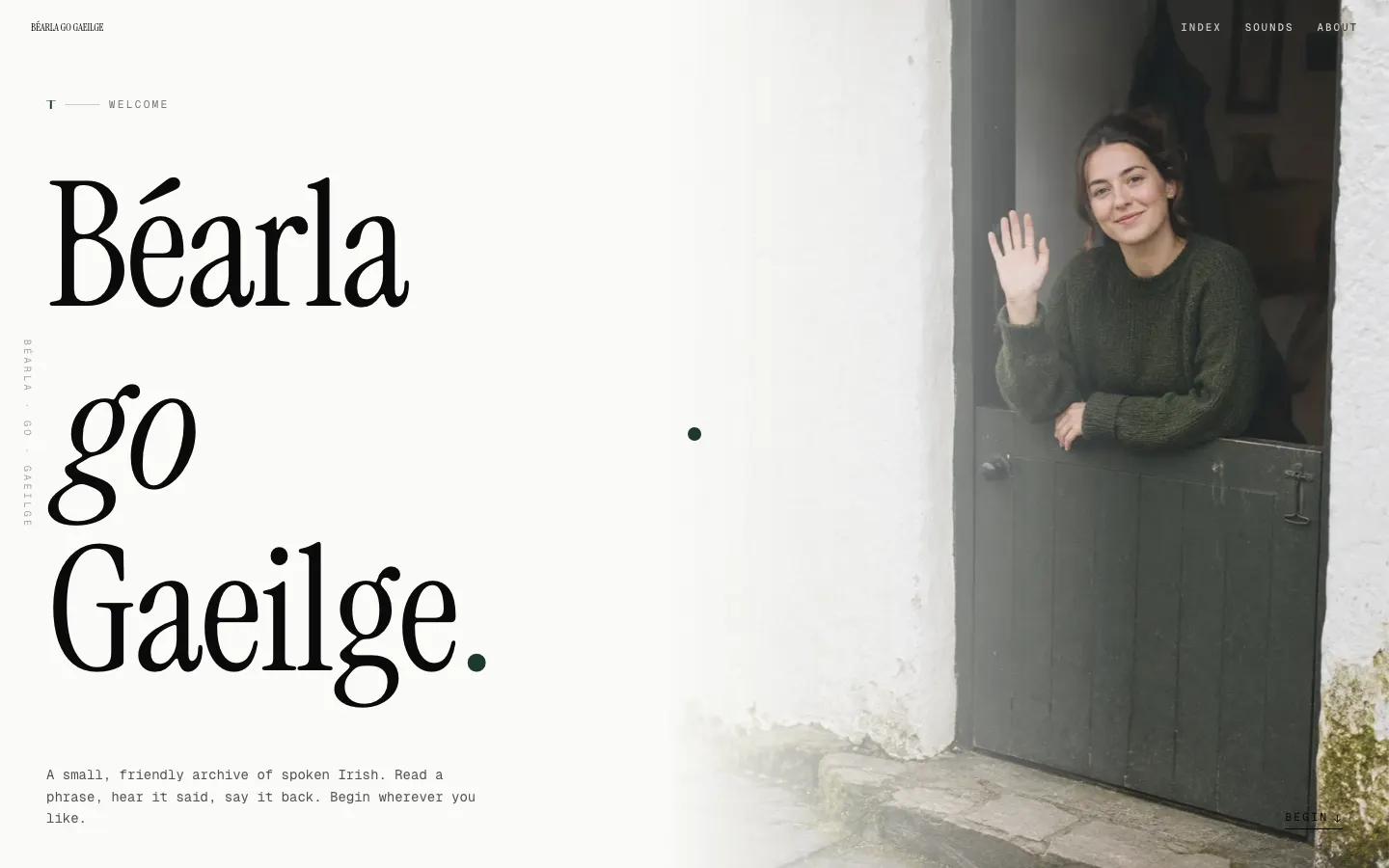
Béarla go Gaeilge means “English to Irish”. It teaches everyday Irish by ear, and OakFox rebuilt it in October 2026, from a phrase archive into a group chat you take part in.
The Problem
The old site called itself “a small, friendly archive of spoken Irish”: 89 phrases in five chapters, each on a card with a photo, the English, a pronunciation guide and a recording. It was pleasant to look through, but:
- Phrases on their own. Each card was one phrase with no conversation around it, so nothing showed when you’d say it or what someone would say back.
- Nothing to come back for. No progress, nothing new tomorrow. You read a chapter once and that was it.
- Heavy on a phone. The Greetings chapter weighed over a megabyte and graded B for carbon, because every card loaded a full-size photo.
- No source code. The files it was built from had been lost, so it couldn’t be changed. The rebuild started from the pages that were live.
The Brief
Make it modern and fun, and forget the usual rules for a learning site. Irish should sound like mates chatting, not like a textbook, and you should be in the conversation, not reading about it. Keep every one of the 89 phrases.
The Solution
A Group Chat
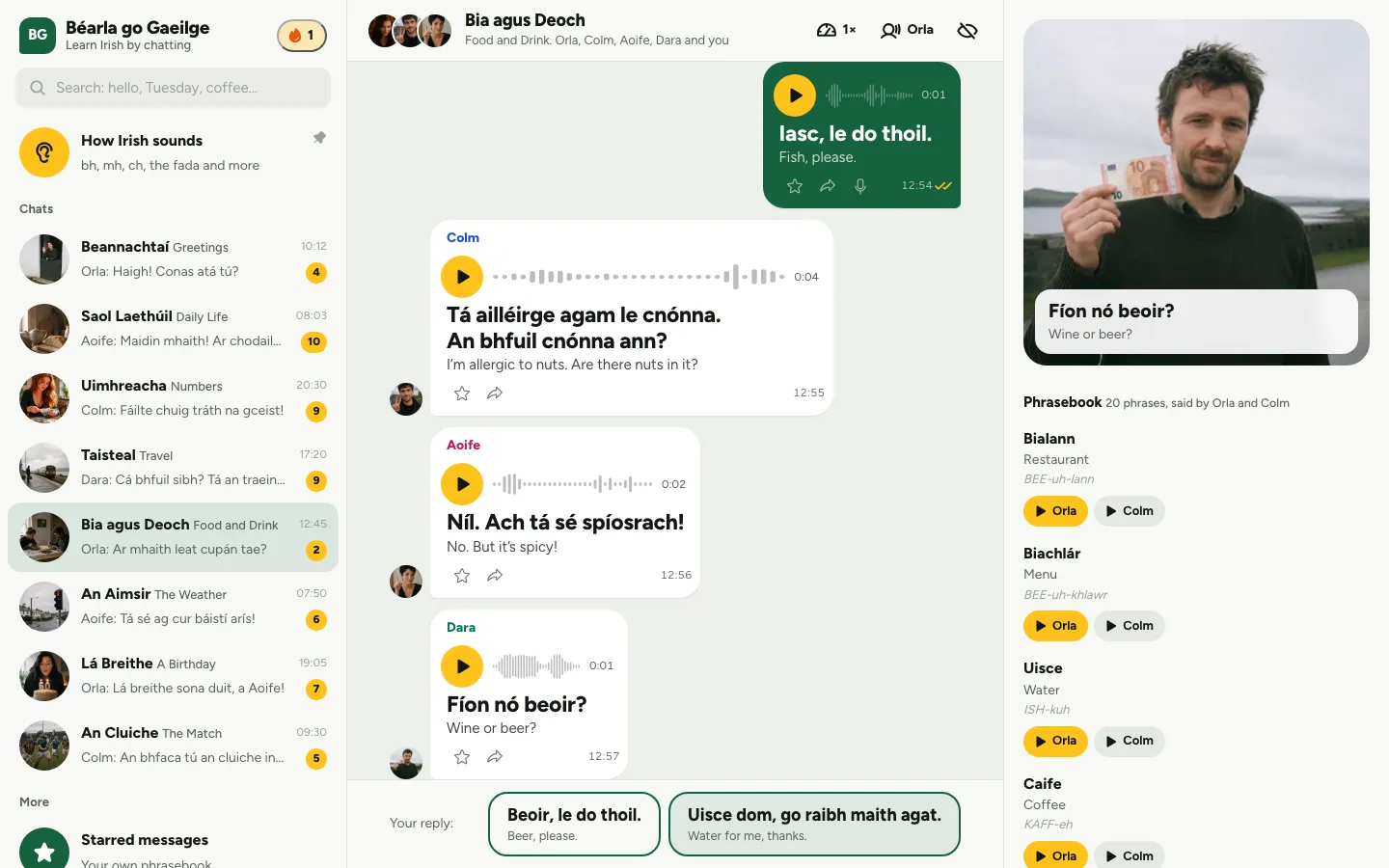
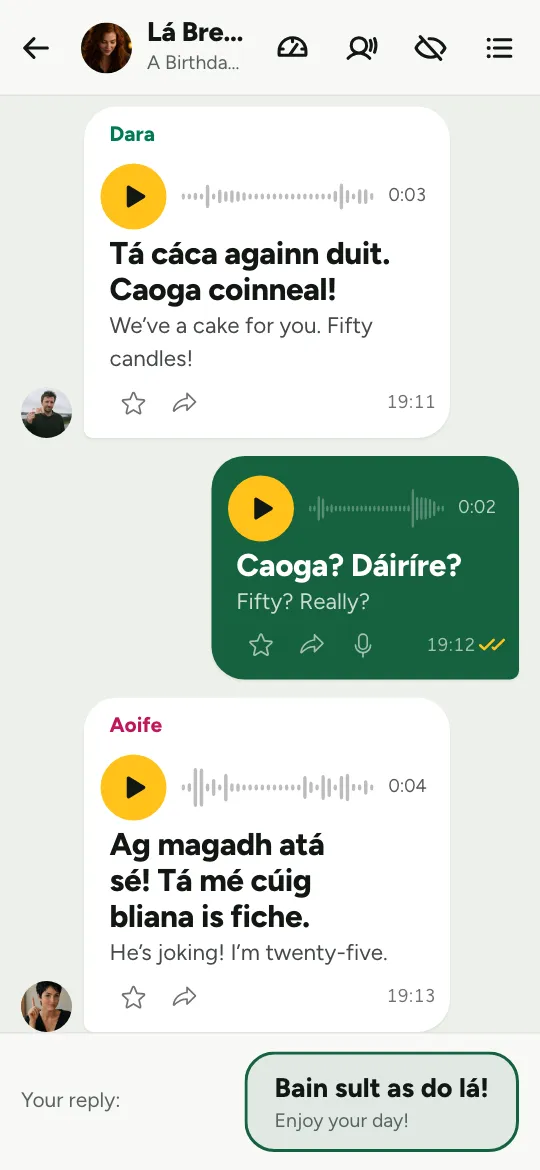
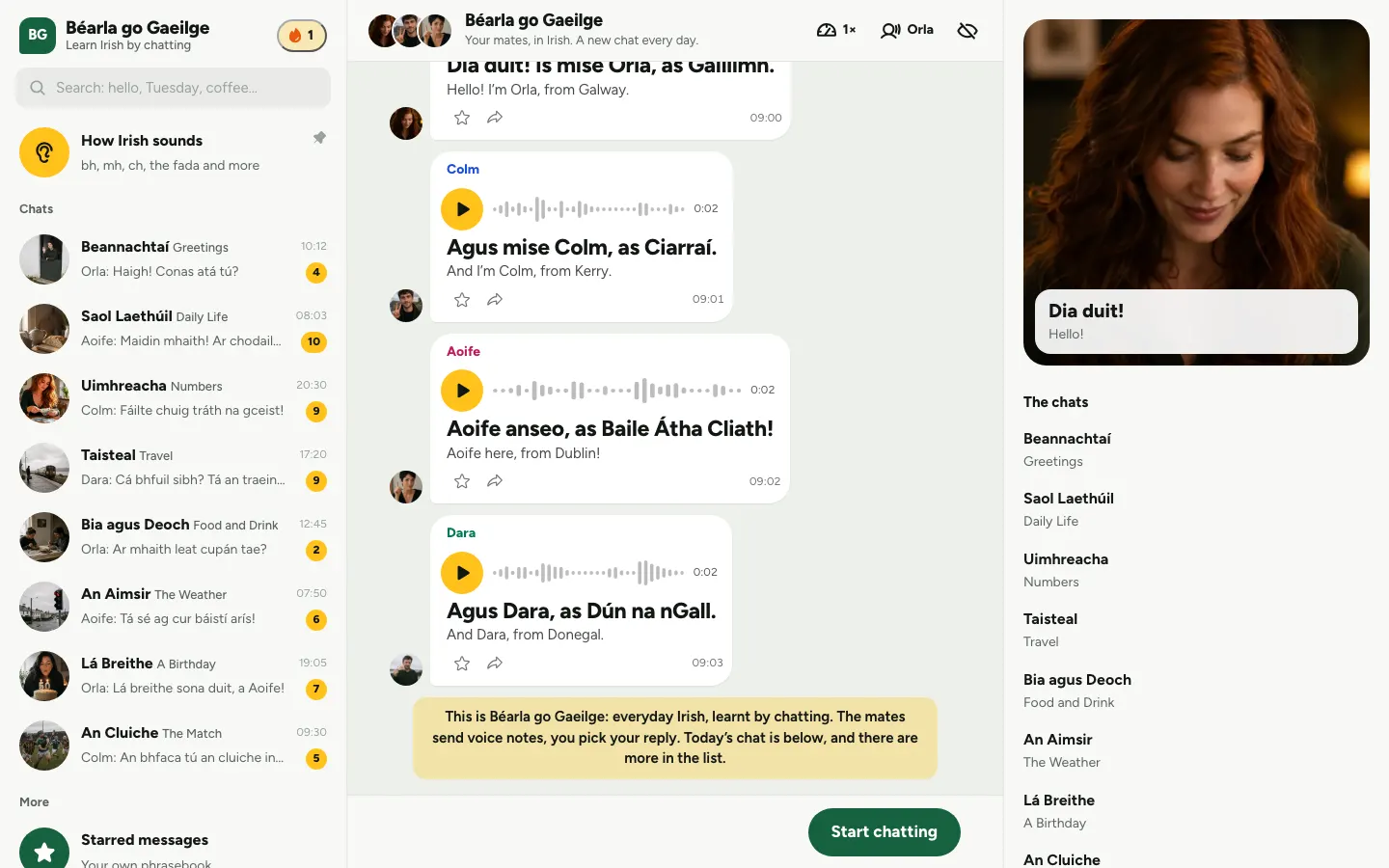
It looks and works like the messaging app already on your phone, so there’s nothing to learn before you start learning Irish. Four mates are in the chat: Orla from Galway, Colm from Kerry, Aoife from Dublin and Dara from Donegal. They send voice notes in everyday standard Irish, the kind learners meet in school and in books, and you pick your reply.
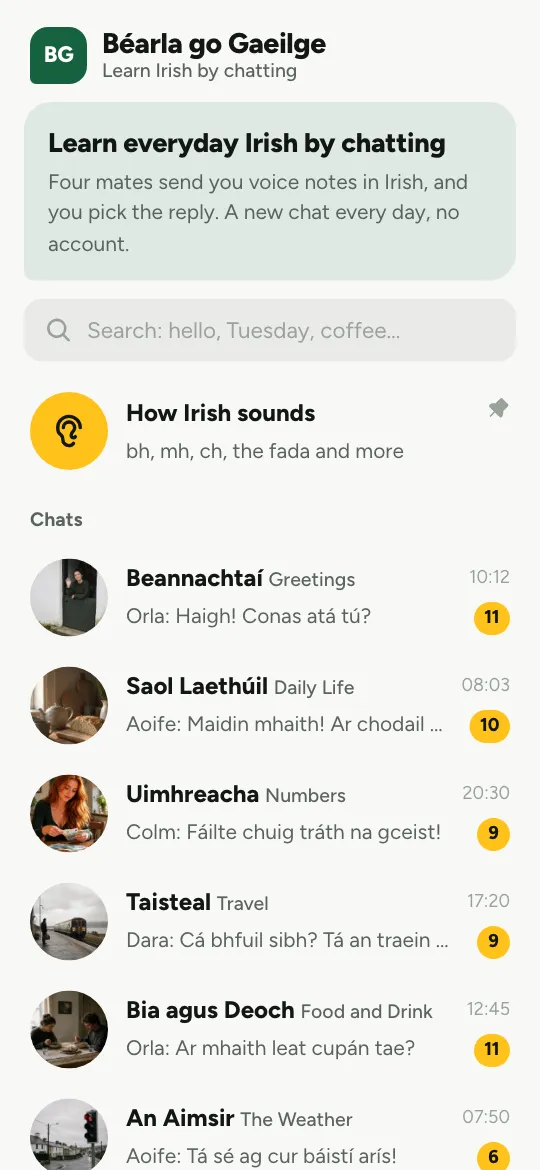
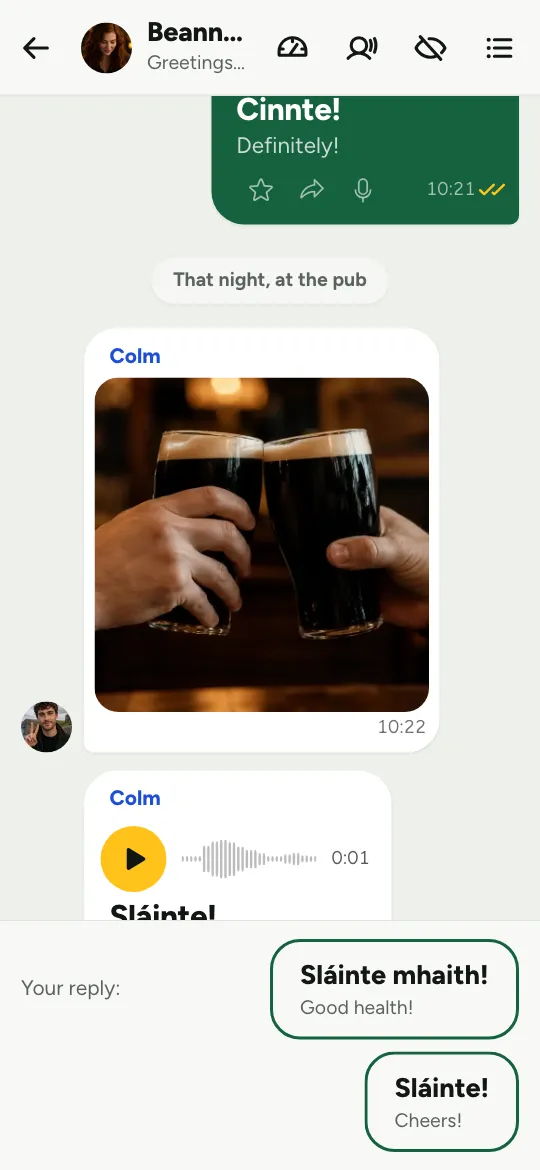
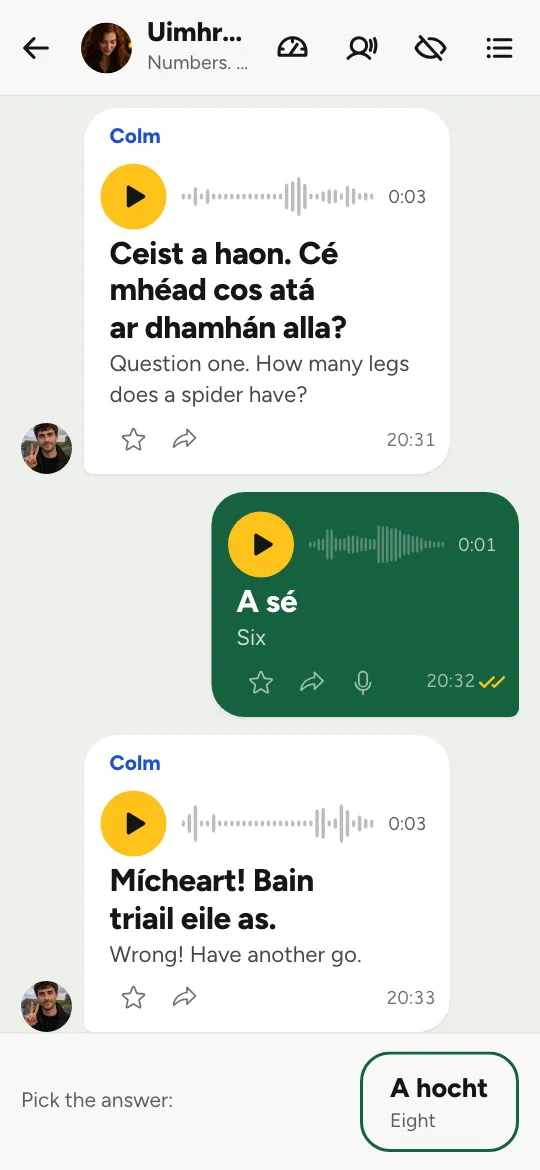
There are eight chats. Five follow the old chapters: a Saturday catch-up and a night at the pub, sorting out a day to meet, a pub quiz, a weekend in Galway and dinner out. Three are new: the weather (rain, again), Aoife’s birthday, and the match with a useless referee.
Colour Palette
- Sage (#E4E9E3) - the background behind the chat list, soft enough to read on for a long time.
- Sent green (#16613F) - your replies, the colour of a message you’ve sent.
- Gorse (#FFC21A) - play buttons and the streak, the yellow of gorse on an Irish hillside.
- One colour per mate - Orla in rust (#C2410C), Colm in blue (#1D4ED8), Aoife in rose (#BE185D) and Dara in green (#047857), so you can see who’s talking at a glance.
The type is Figtree throughout: round, friendly and clear at small sizes, with every Irish letter and fada.
Key Features
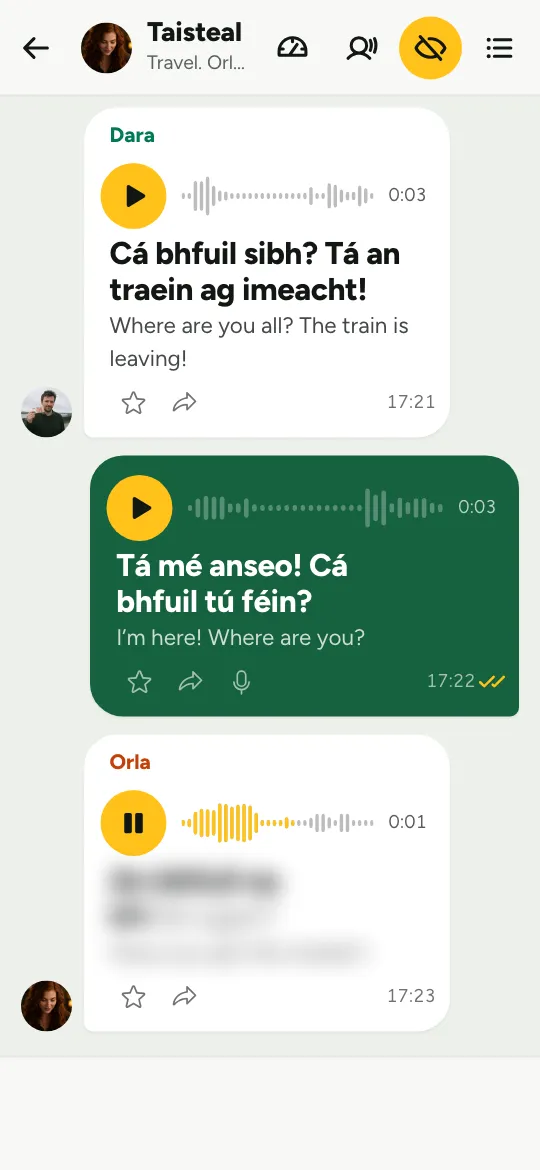
- Voice notes that light up as they’re spoken - the waveform is drawn from the real sound, each letter lights as it’s said, and one tap slows the voice down.
- Pick your reply - choices in Irish with the English underneath. Your reply plays back in a woman’s or a man’s voice, whichever you choose, and in the pub quiz the mates tell you when you’ve got it wrong.
- Hide the words - blur each line until you’ve heard it right through, then tap to peek.
- Say it yourself - record yourself next to any reply and compare it with the voice note. Your recording never leaves your device.
- A new chat every day - three short exchanges that change daily, and a streak for each day you reply.
- The phrasebook beside the chat - all 89 phrases sit next to the chat they belong to, each in both voices with a pronunciation guide. Star any message to keep it, and search finds phrases in English or Irish.
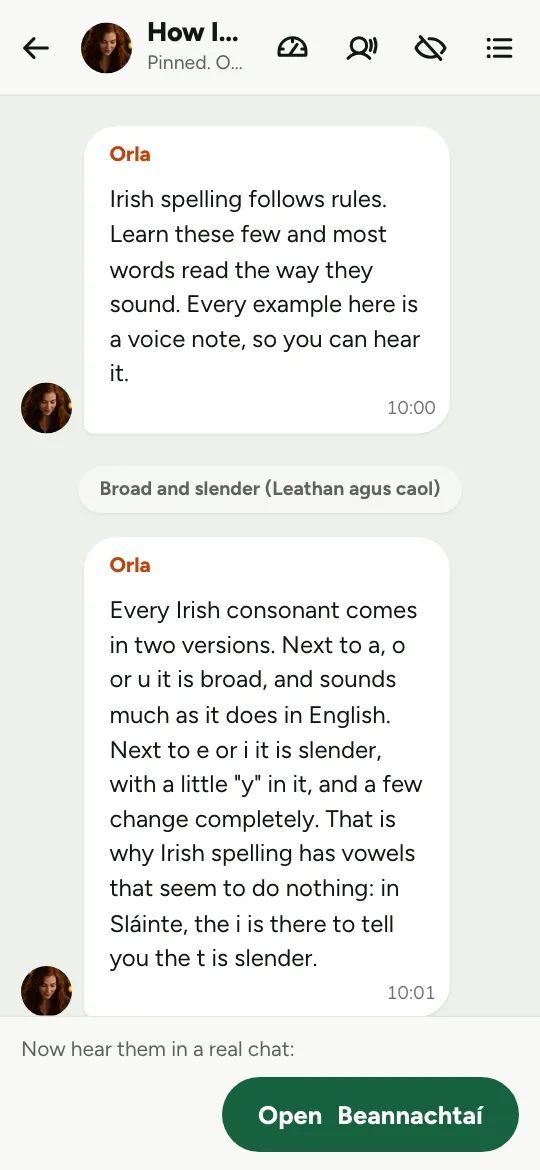
- How Irish sounds - a pinned chat where Orla explains bh, mh, ch, the fada and broad and slender consonants, with every example spoken.
- No account, no app, no ads - what you’ve heard, your streak and your stars stay in your browser.
Fast, and Found
It’s a static site. The full conversation of every chat is in the page itself, so search engines can read all of it, and the phrasebook is marked up as a glossary for them. There’s an llms.txt for AI assistants, IndexNow tells Bing about new pages, and a shared link shows a picture of that chat. Voice notes are small Opus files, about 7 KB each, with a fallback for browsers that can’t play Opus, and each one loads only when it’s played.
Before and After
We measured both sites on 27 October 2026 with the OakFox carbon audit, using its method (Sustainable Web Design, on a green host), and again in a phone browser with the cache off:
| Page | Before | After |
|---|---|---|
| Home, audit tool | 222 KB, 0.028 g, A+ | 96 KB, 0.012 g, A+ |
| Greetings, audit tool | 222 KB, 0.028 g, A+ | 121 KB, 0.015 g, A+ |
| Home, on a phone | 572 KB, 0.071 g, A | 200 KB, 0.025 g, A+ |
| Greetings, on a phone | 1,080 KB, 0.13 g, B | 131 KB, 0.016 g, A+ |
| How Irish sounds, on a phone | 125 KB, 0.016 g, A+ | 95 KB, 0.012 g, A+ |
The Greetings page is 88% lighter on a phone. Most of the saving is the pictures, which now come at the size each screen needs, and the JavaScript is down from 57 KB to 13 KB. These figures are page loads: voice notes load as you listen, so playing the Greetings chat right through adds about 140 KB.
What We Built
- Website design and development (static Astro)
- Eight chats of conversational Irish written for the site, plus a chat of the day
- Voice notes for every line, the phrasebook and the sounds guide, 454 in all
- The chat itself: replies, the quiz, streaks, stars, search, hidden words and recording yourself, all in the browser with no account
- Search and AI-search groundwork: full conversations in every page, structured data,
llms.txt, IndexNow and share images - Carbon measured before and after with the OakFox audit
- Hosting on OakFox’s own server

